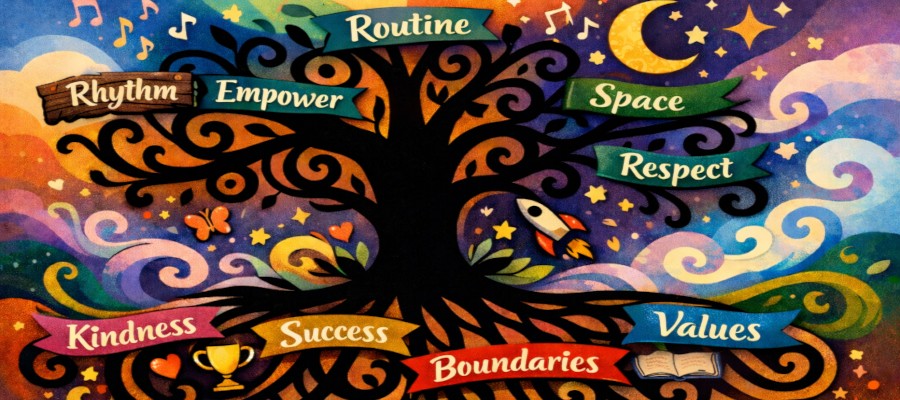
In schools, teachers often begin the year by establishing a classroom ethos—a shared set of values, expectations, and routines that guide how learning takes place. This ethos sets the tone for the classroom, helps children feel secure, and builds a sense of belonging. Many teachers learn about this during teacher training and put this into action year on year.
In homeschooling, the same principle can be just as powerful. By creating a clear learning ethos at home, you signal to your children that there’s a distinction between everyday home life and intentional learning time. It doesn’t mean you have to mimic a school classroom—it’s about shaping an environment where your child feels motivated, respected, and inspired to learn.
Here are 8 areas to consider when creating your own homeschooling ethos:
1. Learning Space
Decide where learning will usually take place. It doesn’t have to be a whole room—it could be a corner of the living room, the kitchen table, or even a tray on the sofa for younger learners. What matters most is consistency, so children begin to associate that space with focus and learning. For example, you might keep a basket of books and supplies that only come out during “learning time.”
Questions to ask yourself:
- Where in our home can we set aside a dedicated learning spot, no matter how small?
- How can we keep resources organised so they’re easy to set up and put away?
- What signals will help my child know we are shifting into “learning mode”?
2. Daily Rhythm and Routine
Establish a predictable flow to your day. This doesn’t mean following a strict timetable, but children thrive on knowing what comes next. You might start with a “morning meeting,” use snack time as a natural break, or always finish the day with reading aloud. Routines create gentle boundaries that help learning feel both structured and relaxed. Imagine your child clearing the breakfast table, bringing out the learning basket, and sitting in the same cosy corner each morning — that small ritual signals something important: now we are learning.
Questions to ask yourself:
- What natural rhythms already exist in our day that I can build learning around?
- Do my children need more freedom or more structure to feel settled?
- What is one daily ritual we could start that signals the beginning of learning time?
3. Respect and Roles
Talk together about how you will respect each other’s time, space, and ideas. In homeschooling, the parent often shifts between being a parent, a guide, and a teacher—children may need clarity about these roles. For instance, you could agree that during learning time, questions are answered as a teacher would, but at lunchtime, you’re back to being mum or dad. This balance can take time to settle — and that’s completely normal.
Questions to ask yourself:
- How can I show my child respect when they’re learning something new?
- How will I encourage turn-taking and listening in our discussions?
- How can I balance my role as both parent and teacher without blurring the lines too much?
4. Attitude to Mistakes
A positive learning ethos treats mistakes as stepping stones rather than failures. If your child sees that you celebrate mistakes as part of the process, they’ll be more willing to take risks in their learning. For example, when something goes wrong, pause and ask, “What did we learn from that?” Small, calm conversations about mistakes help children see them as stepping stones rather than setbacks.
Questions to ask yourself:
- How do I respond when my child makes mistakes—am I modelling a positive outlook?
- What strategies can we use to reflect on mistakes constructively?
- How can I show my child that effort matters just as much as the outcome?
5. Tools and Materials
Your ethos can include how learning tools are cared for and used. For example, you might agree that pencils and books are returned to a basket at the end of the day, or that laptops are only for certain tasks. This not only keeps things tidy but also helps children take ownership of their belongings.
Questions to ask yourself:
- How will we store and organise materials so they’re easy to use and put away?
- Do my children know how to take responsibility for shared tools?
- Are there any resources that are “special” and should be treated with extra care?
6. Celebrating Success
Think about how you’ll acknowledge learning achievements, both big and small. This could be a simple “high five,” displaying work on a wall, or holding a weekly “family showcase” where children share what they’re proud of. Success isn’t just about grades—it’s about progress, effort, and creativity.
Questions to ask yourself:
- How do I usually celebrate my child’s effort, not just their results?
- What small traditions could we start to mark learning milestones?
- How can I encourage my child to recognise their own progress?
7. Boundaries Between Home and School
Because home education takes place at home, it’s easy for the lines to blur. Small boundaries help children know when it’s time to focus and when it’s time to relax. For example, perhaps you only sit at the table during lessons and then move to the sofa for storytime. A change in setting can shift the atmosphere in simple but powerful ways.
Questions to ask yourself:
- How will my child know when learning time begins and ends?
- What cues (location, tone of voice, routines) will help signal the difference?
- How can we balance home comfort with the focus needed for learning?
8. Family Values in Learning
Homeschooling offers the beautiful opportunity to bring your family’s values into education. Maybe your ethos emphasises kindness when working together, perseverance when tackling challenges, or curiosity when asking questions. Perhaps your family practices a particular religion that has values central to your home life. Naming these values and revisiting them in conversation helps them to come alive in daily life.
Questions to ask yourself:
- Which values matter most in our family, and how can they guide learning?
- How can I model those values during teaching moments?
- What practical ways can we remind ourselves of our values each week?
Final Thoughts
Creating your own learning ethos at home is not about strict rules—it’s about building a shared understanding of how learning feels in your family. When children sense a shift from “home” to “learning at home,” it gives structure, meaning, and joy to the process. A clear ethos supports confidence, independence, and a love of learning that will grow with your child. A strong learning ethos doesn’t just shape daily lessons — it shapes how your child sees themselves as a learner.
By nurturing your learning ethos at home, you’ll empower your child’s learning—one step at a time.
Related reading
If you are developing your own learning ethos, it can be helpful to step back and explore the wider framework of homeschooling, including different approaches, routines, and educational philosophies.
You can explore the complete guide here:
The Complete Guide to Homeschooling